

The line at the top of a resume used to be an objective: "Seeking a challenging position where I can grow my skills." Most recruiters skip those now, and a summary usually takes its place. In a few cases, though, an objective is still the better choice.
Objective vs summary
An objective says what you want: the job, the field, the next step. A summary says what you offer: your experience, your skills and what you've done with them. A recruiter reads the top of your resume to decide whether you fit the job, and the summary answers that. An objective mostly answers a different question, what you're hoping for.
So if you have relevant work experience, which covers most people, use a summary. Three or four lines will do: who you are in the employer's words, what you're good at, and one result.
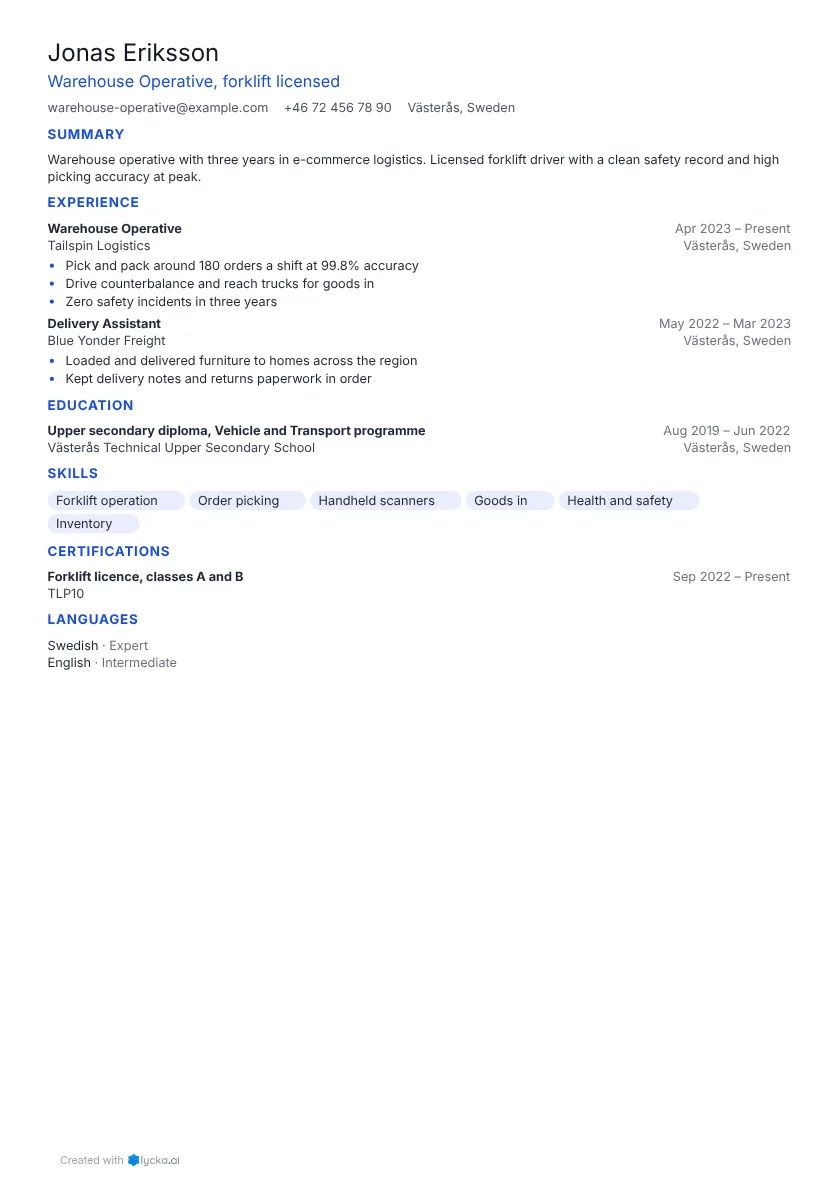
Warehouse operative with four years in a high-volume distribution centre. Reach truck licensed, 99.8% picking accuracy, and trusted to train new starters.
Our guide to the resume summary covers the formula in more detail.
When an objective still works
An objective earns its place when your experience doesn't yet explain why you're applying. That tends to happen in three situations.
For a first job, you have little to summarise, so say what you're looking for and what you bring to it.
Upper secondary student looking for a part-time cashier job. Used to handling cash, and free evenings and weekends.
In a career change, your past titles point one way and the job points another. One line about the move tells the reader to read your experience with the new job in mind.
Hospitality supervisor moving into B2B sales, with six years of upselling and building a base of regular customers.
Internships, apprenticeships, seasonal work and graduate programmes are the third case. Employers often fill several openings from one round of applications, and naming the one you want shows you applied on purpose.
Electricity and Energy student seeking an electrician apprenticeship in Uppsala from June.
Writing a good one
Even an objective should be mostly about the employer.
- Name the job. "A part-time cashier job" says more than "a role in retail".
- Add one or two concrete things you bring: a licence, a skill, a schedule, a result.
- Keep it to two lines. Any longer and it starts to read like a cover letter.
Leave out wishes that only help you, like "a role where I can grow" or "a company that values work-life balance". They may be true, but they don't help the reader decide.
Plenty of good summaries end with a short objective, which works well for students and career changers:
Nursing student with 1,800 placement hours across surgical and community care. Registered from September and looking for a first post on a surgical ward.
The first sentence is the summary and the second is the objective.
Examples by situation
- Student, first job: see the cashier and first job examples.
- Graduate: see the college student example.
- Career change: see retail to HR and our guide to the career change resume.
- Experienced: use a summary. See any example in your field on the resume examples page.
Whatever you end up calling it, read the top of your resume as the recruiter would. If it tells you what this person does and why they suit the job, it works. If it only tells you what they want, rewrite it as a summary. And if you have no experience yet, our guide to a resume with no experience shows what to put on the page instead.